

Explore Our new shop
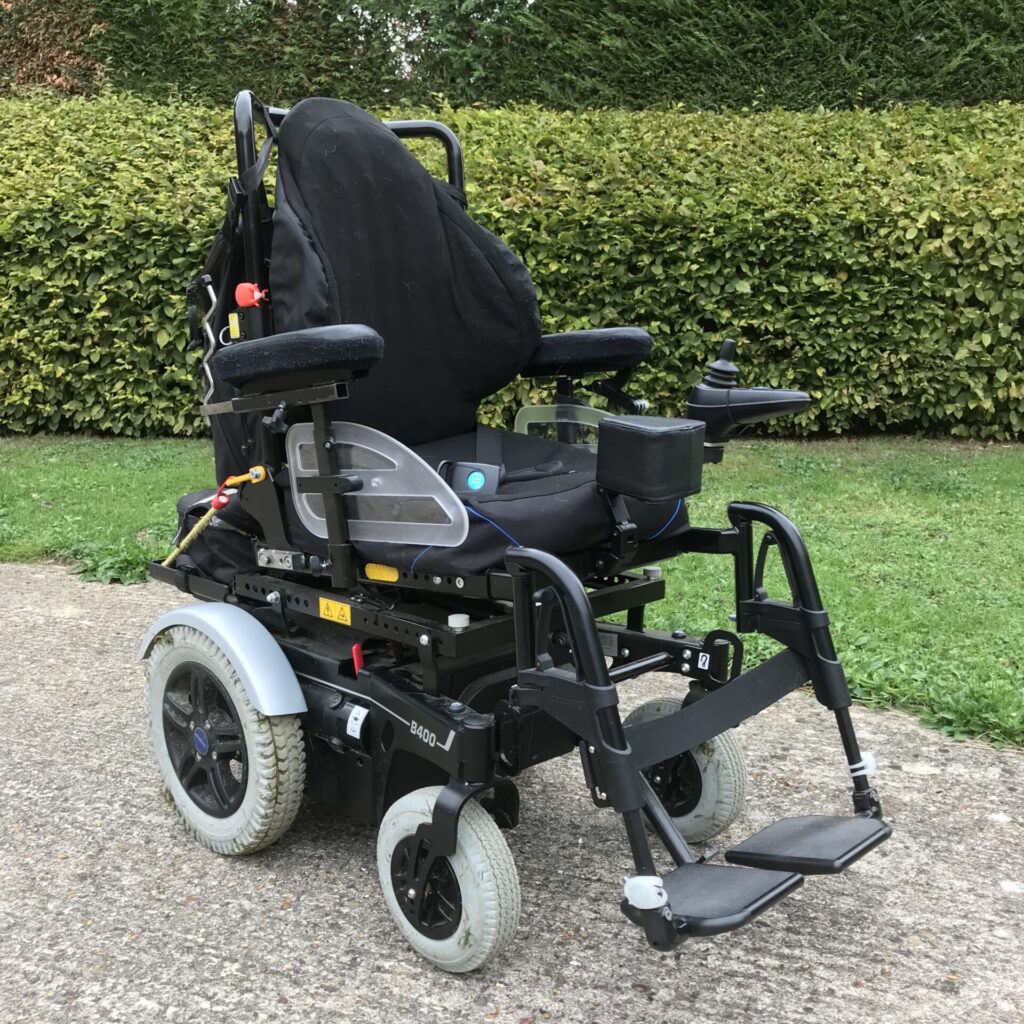
Wheelchair Description:
Black-frame with rear-wheel drive, which is suitable for use indoors and outdoors. Two desk arms, a kerb climber, an electrically moveable backrest, and a seat that can tilt backwards 45 degrees. Removable footplates, feet straps, and a pressure-relieving pommel between my legs. Matrix TR backrest with Vicair air-cushioning, along with a Vicair Academy seat cushion.
Battery Life:
I’ve been out shopping all day, or on longish walks, but have never attempted to go more than about 5 miles at a time.
Source Of Wheelchair:
RMS Prepared It For Wheelchair Services
Diagnosis:
Spinal Cord Injury (SCI), Paraplegia, Neurosarcoidosis
Personal Opinion:
Despite the official label, this is more of an indoor chair than an outdoor one. It is narrow enough to fit through most doors and compact enough to use in quite tight spaces, and the kerb climber handles small steps – indoors or out. It performs well on flat surfaces, even quite rough surfaces (my casters are the chunkiest I could get), is reasonable on hills (helped by having smaller anti-tipping wheels than normal), but is hopeless on a sideways camber. I regularly use it around town, but need to be careful when passing dropped kerbs so that it doesn’t spin round sideways into the road.
As with most power chairs, a wheelchair-accessible vehicle is the only sensible way to transport it, and I drive a VW Caravelle with a side lift. Putting tie-down points out of reach of the occupant on any chair is unnecessary and, I believe, a design fault. Whether this is an issue will depend on the individual, but it is important to someone like me who drives themselves and may not have anyone with them. An automatic tie-down system involving attaching straps to the bottom of the chair could have been an option, but it reduces ground clearance. I have always preferred (and am able) to manage an alternative strapping system, and I frequently go over ground rough enough to require the maximum clearance possible.
The kick strap, which runs from one footplate to the other to prevent my feet from slipping back, makes removing the footplates somewhat awkward. However, the heel-loops available were a worse option, and I rarely need to remove the footplates anyway. All the conventional oxygen cylinder holders I know hold cylinders upright and high, protruding at the back of the chair with knobs I can neither read nor reach to turn; therefore, being able to lie a cylinder sideways just behind the backrest worked relatively well. I also have a Matrx TR backrest to provide lateral support, coupled with Vicair air-cushioning for pressure relief, and a Vicair Academy seat cushion to accommodate the asymmetry of my lower trunk.
I really had to fight for this chair. It took 1 year and 8 months for the Wheelchair Services to produce something that genuinely suited my needs finally, but it was worth it in the end. I would have preferred something with better outdoor capabilities, but that would have been at the expense of the narrow width and indoor capability. I am lucky enough also to have a very ancient outdoor/indoor chair that I keep for country walks, and the pair of chairs suit me well.
SHARE PREVIEW